Vienna just chose its voices: Victoria Swarovski and Michael Ostrowski to host Eurovision 2026
Eurovision host announcements always trigger the same internal fan ritual. You read the names. You pause. You imagine them saying “Good evening, Europe”. You decide, within roughly three seconds, whether this feels right.
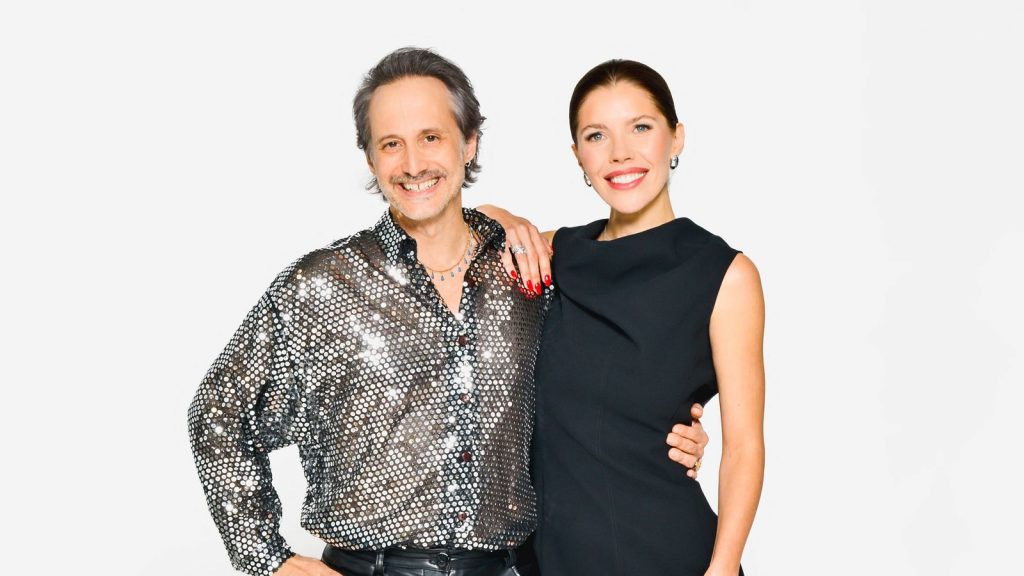
Austria’s answer for 2026 is Victoria Swarovski and Michael Ostrowski. And honestly? It lands.
Not in a fireworks-and-confetti way. Not in a “this will break the internet” way. More in that quietly confident, “we’ve thought about this” kind of way that tends to age well.
Victoria Swarovski has been orbiting big television formats for years now, but she never feels overexposed. That balance is harder to achieve than it sounds. She started out in music as a teenager, moved through pop releases, spent time in Los Angeles, and eventually became a familiar face to millions through Let’s Dance, first as a contestant, then as a judge, and later as one of the show’s main presenters.
If you have ever watched German-language entertainment TV, you have almost certainly seen her glide through a live broadcast without visible effort. Awards shows, anniversary specials, large-scale productions, glossy stages, tight schedules. This is her natural habitat.
What makes her interesting as a Eurovision host is not just polish, though. It is range. She runs a beauty brand, designs fashion, models internationally, and still occasionally surprises everyone by doing something wildly outside the comfort zone, like entering the Dakar Rally. That mix of glamour and “why not?” energy fits Eurovision better than a perfectly curated biography ever could.
Michael Ostrowski comes from a different corner of the creative world, and that contrast is doing a lot of the heavy lifting here.
He is first and foremost an actor, widely associated with comedy, but his career refuses to stay inside one lane. He writes screenplays. He directs films. He adapts his own novels for cinema. He moves comfortably between absurd humour and grounded storytelling. On Austrian television, he has become a familiar hosting presence at major cultural and music events, which means he knows how to talk to both a theatre audience and a living-room audience without changing personality every five seconds.
That matters at Eurovision. The show constantly switches tone. One moment you are introducing an emotional ballad in Portuguese. The next moment you are smiling through a chaotic postcard involving inflatable props. A host who understands rhythm and timing is not a luxury. It is structural.
Together, Swarovski and Ostrowski feel complementary rather than symmetrical. She brings the sleek, international-facing confidence. He brings warmth, wit and a slightly mischievous edge. Neither feels like a novelty choice. Neither feels like a panic pick.
ORF has said they developed a hosting concept before attaching names to it, which is broadcaster-speak for “we tried not to improvise this in a meeting five minutes before lunch.” And it shows. This pairing feels designed, not accidental.
There is also something reassuringly Austrian about it. Not in a tourist-board sense. More in the way that both hosts are deeply rooted in the country’s contemporary cultural landscape without being locked into one stereotype. They represent different creative traditions, different audiences, different energies. That diversity within a single nation is very Eurovision, whether anyone explicitly says it or not.
Vienna hosting Eurovision again already carries symbolic weight. The contest has changed enormously since Austria last welcomed Europe. Platforms are different. Audiences are different. The fandom is louder, faster, and armed with screenshots. Choosing hosts who are comfortable in modern media ecosystems is not optional anymore.
Swarovski understands branding and global visibility. Ostrowski understands storytelling and humour. Between them, they understand live television.
No host duo can guarantee a perfect show. Eurovision does not work like that. Something will go wrong. A microphone will misbehave. A timing cue will be missed. A joke will land in some countries and faceplant in others.
What good hosts do is absorb those moments and keep everything moving.
On paper, Victoria Swarovski and Michael Ostrowski look capable of exactly that.
And sometimes, for Eurovision, “capable” is actually a very high compliment.
Vienna, May 2026. Europe, Australia, the world. Two familiar Austrian faces stepping into one of the strangest, brightest, most unforgiving jobs in television.
No chaos promised. No miracles guaranteed.
Just a hosting duo that makes sense.
Which, in Eurovision terms, is already a small victory.
Source: EBU