Portugal’s Festival da Canção returns… with “Fumo” in the Final and controversy in the wings
Festival da Canção is usually the soothing kind of national final, the one that doesn’t shout for your attention because it knows you’ll come closer anyway, but this year the opening night arrived with a little extra tension baked into the lighting rig, because Portugal isn’t just choosing songs, it’s navigating a public debate about what participation even looks like in 2026, and several competing artists have already said the Eurovision stage in Vienna would be a step they would refuse to take, even if they won the whole thing.
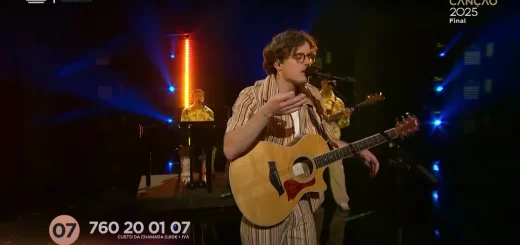
Still, the show went on, because of course it did. Semi-Final 1 launched the 60th edition from the Valentim de Carvalho studios in Paço de Arcos, with that very RTP flavour of television polish, crisp camera work, and a stage that looks more “prime-time studio confidence” than any artsy fantasy people like to project onto Portugal every year. Hosting duties were led by Vasco Palmeirim, with Catarina Maia and Alexandre Guimarães guiding the night’s flow and the green-room nerves.
Running order
Dinis Mota – “Jurei”
Nunca Mates o Mandarim – “Fumo”
Evaya – “Sprint”
André Amaro – “Dá-me a tua mão”
Bateu Matou – “Nos teus olhos”
Marquise – “Chuva”
AGRIDOCE – “Onde quero estar”
Mário Marta – “Pertencer”
How qualification worked
Portugal kept the structure that always feels faintly sadistic in the nicest possible way. Round one combined jury and public to send four songs straight to the Final, and then RTP reopened the televote for a second round, letting the public alone decide the fifth finalist, which is basically the format’s way of saying: we like consensus, but we love suspense.
Results
The four direct qualifiers were:
Nunca Mates o Mandarim – “Fumo”
Marquise – “Chuva”
Dinis Mota – “Jurei”
Evaya – “Sprint”
Then, after the televote reopened, the fifth ticket to the Final went to:
André Amaro – “Dá-me a tua mão”
So Semi-Final 1 ends with a Final line-up that already has texture: “Fumo” arrives with that “we’re not here to be background music” energy, “Chuva” brings the kind of tasteful mood Portugal can sell better than most countries can even spell, and André Amaro sneaks in via the second-round public vote, which is always the most flattering way to qualify because it comes with an aftertaste of “people actually pressed the button for this.”
The elephant is still very much in the room. Multiple Festival da Canção acts have publicly said they would boycott Eurovision 2026 if they won, and reporting around RTP’s approach makes clear that this year the Festival winner is not automatically locked in as Portugal’s Eurovision representative, which means the Final is not just a competition for a trophy, it’s also a test of what “winning” even means under these conditions.
And yet, for one night at least, the music did what it always does in Portugal: it demanded attention without screaming, it created a Final shortlist with actual personality, and it reminded everyone why Festival da Canção still feels like its own little universe, even when the real world insists on leaning into frame.