No English Switch Here: Montenegro Is Taking Montenegrin to Eurovision 2026
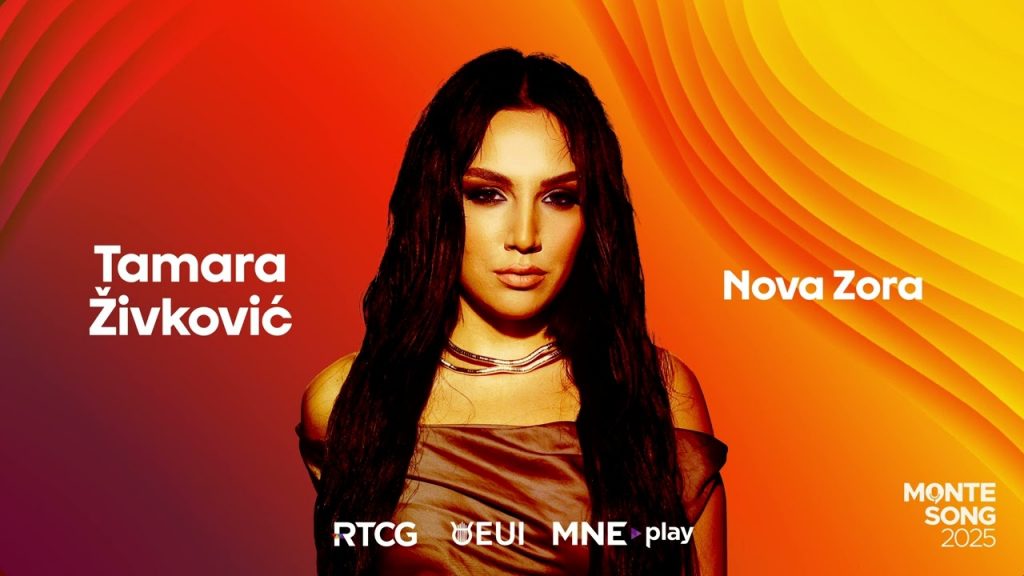
In a Eurovision season where “English version incoming” has become almost a reflex, Tamara Živković is doing something quietly radical. She’s not translating. She’s not adapting. She’s not softening the edges.
Montenegro will perform in Montenegrin at the Eurovision Song Contest 2026 — and Tamara isn’t treating that choice like a risk that needs explaining.
It’s just… how the song works.
“Nova Zora” Isn’t Asking for Permission
After winning Montesong last December, Tamara confirmed that “Nova Zora” will stay exactly as it is when it reaches the Eurovision stage. There will be an English version, yes — released later as a thank-you to international fans — but not for the contest itself.
And that distinction matters.
Because this isn’t about rejecting accessibility or ignoring the wider audience. It’s about the song’s identity. Tamara has been clear that “Nova Zora” never lost its meaning, even after winning. The language is part of the message, not a barrier to it.
From Almost to Absolutely
Two years ago, Tamara’s Eurovision journey stalled quietly. Her previous entry didn’t catch public votes, and she left Montesong without a ticket, without noise, without bitterness.
This time, she arrived differently.
“Nova Zora” was already marked as a favourite before the final. When the votes were counted, the gap was clear: 22 points combined from jury and televote, a comfortable lead that didn’t really invite conspiracy theories to survive long.
Even so, Tamara admits the win didn’t land instantly. That frozen moment when your name is called and reality takes a second to catch up? Very real. Very human.
A Eurovision Fan Who Knows What Stage She Wants
Tamara doesn’t frame Eurovision as a career move. She talks about it like a place she recognised long before she ever stood on a national final stage.
She doesn’t remember the first year she watched the contest. She remembers the feeling. That sense of this is where I belong one day. The kind of thought that stays with you even after a loss.
And crucially, she’s honest about this: even if she hadn’t won this year, she would have tried again.
That persistence shows in how firmly she’s standing by her choices now.
Language as Part of the Statement
Written by Boris Subotić, “Nova Zora” is framed as transformation, release and self-definition. Tamara describes it as a quiet rebellion — not loud, not slogan-heavy, but deliberate.
For her, keeping Montenegrin isn’t nostalgia. It’s coherence.
She’s clear that the song speaks directly to issues of identity and equality that still feel unresolved in the region. Translating it for the Eurovision stage, she suggests, would dilute that immediacy rather than strengthen it.
About the Criticism (Briefly)
Yes, there were comments. There always are.
Some questioned the result. Others picked at vocal details from the final performance. Tamara’s response has been notably unexcitable. She points to audience reactions, streaming numbers and social media engagement across platforms as a more honest indicator of how the song landed.
Not everything needs a rebuttal. Especially when the support is visible.
Vienna, But Make It Montenegrin
Tamara is already working on refining the staging for Vienna, building on the visual language introduced at Montesong. The focus remains transformation — movement, release, confidence — without overloading the message.
Singing and dancing simultaneously was new territory for her, and she’s candid about still learning how to balance both. Eurovision, she notes, isn’t just about sounding good. It’s about what you transmit.
With 35 countries set to compete at the Wiener Stadthalle, Montenegro’s entry won’t shout to be understood.
It will simply be itself.
In a Contest That Often Translates, This One Stays Put
Eurovision 2026 will have plenty of English. That’s not going to change.
What makes Montenegro stand out already is that it isn’t trying to blend in linguistically. “Nova Zora” is arriving in Vienna as it was written, sung in the language it was meant for, trusting that emotion doesn’t need subtitles.
Sometimes that confidence says more than any adaptation ever could.
And that, quietly, might be Montenegro’s strongest move this year.
Source: cdm